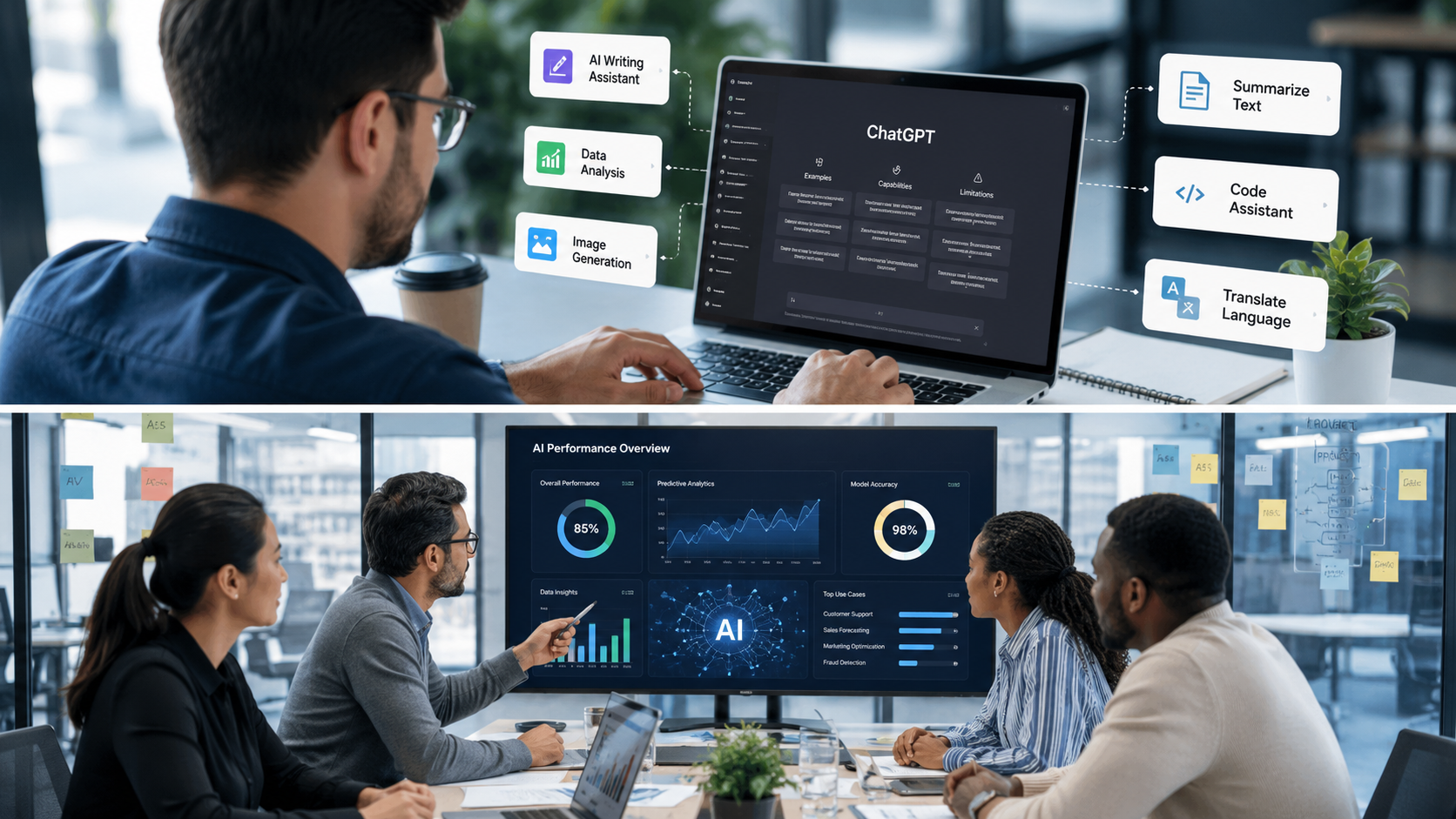
Artificial intelligence isn’t just something tech companies talk about anymore. It’s showing up almost everywhere. Whether you’re applying for your first job, trying to earn a promotion, or thinking about switching careers, chances are you’ll hear one question sooner rather than later:
“Do you know how to use AI ?”
A couple of years ago, having AI experience looked impressive on a resume. In 2026, it’s quickly becoming something employers simply expect. The good news? You don’t need a computer science degree or years of coding experience to keep up.
Many companies aren’t searching for people who can build the next ChatGPT from scratch. Instead, they want employees who know how to use AI to solve everyday problems, save time, and make smarter decisions.
That’s exactly what this guide is about.
You’ll learn the Top AI Skills Employers Want in 2026, why these skills matter, and how you can start building them today – even if you’re a complete beginner.
Why AI Skills Matter More Than Ever
Take a look around your workplace – or imagine your future one. AI is helping people answer emails, create presentations, analyze spreadsheets, write reports, design graphics, schedule meetings, and even brainstorm new ideas.
Instead of replacing every worker, AI is changing how people work.
Think of AI like a calculator.
The calculator didn’t eliminate accountants. It helped them work faster and focus on bigger financial decisions. AI is doing something similar for almost every profession.
Companies now want employees who can work with AI, not compete against it.
According to industry reports from organizations like the World Economic Forum, LinkedIn, and Microsoft, AI literacy has become one of the fastest-growing workplace skills across industries.
Some examples include:
- Marketing teams creating campaigns faster
- Customer service agents using AI to answer questions
- Teachers building lesson plans
- HR professionals screening resumes
- Sales teams writing personalized emails
- Small business owners automating repetitive tasks
No matter what career you’re interested in, learning AI is becoming one of the smartest investments you can make.
Read also :- Top AI Tools for Small Businesses in the USA ( 2026 Guide )
The Biggest Change Employers Are Looking For
Here’s something many people get wrong.
Companies don’t expect everyone to become AI engineers.
What they’re really looking for is employees who can think like problem-solvers.
Imagine two workers.
Person A
“I’ve never used AI before.”
Person B
“I used AI to summarize meeting notes, create a draft presentation, organize project ideas, and automate repetitive work.”
Which one sounds more valuable?
Exactly.
Employers love candidates who can combine human creativity with AI efficiency.
That’s becoming a huge advantage in hiring.
Top AI Skills Employers Want in 2026
Not every AI skill is equally valuable.
Some are becoming must-have abilities across almost every industry, while others are useful only for specialized technical jobs.
Let’s start with the skills that employers consistently mention during hiring.
1. AI Prompt Writing ( Prompt Engineering )
If you’ve ever asked ChatGPT a question, you’ve already used prompt writing.
But writing great prompts is a skill.
A vague request usually produces a vague answer.
A detailed request often produces something surprisingly useful.
For example:
Instead of saying:
“Write an email.”
You could say:
“Write a friendly follow – up email to a customer who downloaded our free guide but hasn’t purchased yet. Keep it under 150 words with a professional tone.”
See the difference ?
The second prompt gives AI much better direction.
That’s exactly what employers want.
Why It Matters
Employees who write better prompts often:
- Save hours every week
- Produce higher – quality work
- Need fewer revisions
- Improve team productivity
How to Improve Prompt Writing
Try these habits:
- Give AI clear instructions.
- Add context.
- Explain your audience.
- Mention the desired tone.
- Ask AI to improve its own answer.
- Keep experimenting.
Prompt writing is one of those skills that gets better every single week you practice.
Read also :- Top AI Tools for Small Businesses in the USA ( 2026 Guide )
2. AI Research Skills
Searching Google is one thing.
Researching with AI is another.
Modern AI assistants can summarize reports, compare products, explain complicated topics, and organize information in seconds.
That doesn’t mean you should trust every answer.
Good employees know how to verify AI – generated information before using it.
That’s an important skill.
Employers Want People Who Can
- Ask smart research questions
- Compare multiple sources
- Fact-check AI responses
- Identify outdated information
- Summarize complex topics
For example, imagine you’re preparing a report about electric vehicles.
Instead of spending four hours reading articles, AI can organize the information first. You then verify the facts, add insights, and create the final report.
That’s working smarter – not cutting corners.
3. AI Content Creation
No, this doesn’t mean letting AI do all your work.
The best professionals use AI as a starting point.
Marketing teams use AI for:
- Blog outlines
- Email campaigns
- Product descriptions
- Social media ideas
- Video scripts
- Ad copy
Writers still edit everything before publishing.
That’s the difference between average work and professional work.
Employers appreciate people who understand that AI helps create the first draft – but human judgment makes it worth reading.
Practical Example
Imagine your manager asks for ten Instagram caption ideas before lunch.
Writing them manually might take an hour.
Using AI to brainstorm ideas could cut that time in half, giving you more time to polish the best options and focus on strategy.
That’s the kind of efficiency employers notice.
Read also :- Top AI Tools for Small Businesses in the USA ( 2026 Guide )
4. AI – Powered Data Analysis
You don’t have to be a data scientist to benefit from AI.
Many businesses collect huge amounts of information every day- sales numbers, customer feedback, website traffic, inventory, marketing results, and more.
The challenge isn’t finding data.
It’s making sense of it.
AI tools can help spot trends, summarize reports, identify unusual patterns, and even suggest possible next steps.
Imagine you’re looking at a spreadsheet with thousands of customer reviews. Reading every comment could take days. AI can group similar feedback, highlight common complaints, and identify what customers love in just a few minutes.
That doesn’t replace your judgment. Instead, it gives you a much faster starting point for making informed decisions.
Skills Employers Appreciate
- Reading AI – generated reports
- Understanding charts and dashboards
- Finding meaningful trends
- Asking follow – up questions
- Making decisions based on data instead of guesswork
These abilities are becoming valuable in marketing, finance, healthcare, retail, education, human resources, and many other industries.
AI Skills Are Becoming ” People Skills “
Here’s an interesting shift happening in 2026.
A few years ago, AI was mostly associated with programmers and software engineers.
Today, that’s no longer true.
Teachers use AI to create lesson plans.
Real estate agents use it to write property descriptions.
Small business owners automate customer emails.
Sales teams personalize outreach.
Designers brainstorm creative concepts.
Even healthcare workers are using AI to simplify paperwork and organize information.
In other words, AI isn’t replacing communication, creativity, or teamwork.
It’s making those human skills even more valuable.
The professionals who stand out are the ones who know when to rely on AI – and when to rely on their own experience, judgment, and common sense.
That’s a combination employers are actively looking for, and it’s likely to stay important for years to come.
Read also :- Top AI Tools for Small Businesses in the USA ( 2026 Guide )
5. AI Automation Skills
One of the biggest reasons companies invest in AI is simple – they want to save time.
Think about how many repetitive tasks happen every day:
- Copying information between apps
- Sending follow – up emails
- Scheduling meetings
- Updating spreadsheets
- Organizing files
- Creating weekly reports
These jobs aren’t difficult, but they can eat up hours every week.
That’s where AI automation comes in.
Instead of doing the same task over and over, employees can create simple workflows that handle much of the work automatically.
You don’t have to be a programmer to do this. Many modern AI automation tools use drag-and-drop interfaces that are beginner-friendly.
Why Employers Love Automation Skills
If you can automate a task that normally takes two hours every week, you’ve just saved your company over 100 hours in a year.
That’s a pretty impressive accomplishment.
Companies appreciate employees who ask questions like:
- Can this process be automated ?
- Is there a faster way to do this ?
- Can AI reduce manual work ?
Those are the kinds of people managers remember.
Where Automation Is Used
AI automation is becoming common in:
- Marketing
- Customer support
- Human resources
- Accounting
- Sales
- Healthcare
- Education
- E-commerce
Even small businesses are using AI to automate customer emails, appointment reminders, and inventory updates.
Read also :- Top AI Tools for Small Businesses in the USA ( 2026 Guide )
6. Critical Thinking with AI
Here’s something every employer worries about.
Some people copy AI answers without checking if they’re correct.
That’s a problem.
AI is incredibly helpful, but it can still make mistakes, misunderstand questions, or provide outdated information.
The best employees don’t blindly trust AI.
They verify.
That’s why critical thinking has become one of the most valuable AI skills in 2026.
What Critical Thinking Looks Like
Instead of asking:
“Is this AI answer correct?”
Ask questions like:
- Where did this information come from ?
- Does it make sense?
- Can I verify it ?
- Is anything missing ?
- Would an expert agree ?
These habits help you avoid costly mistakes.
Real – Life Example
Imagine AI tells you a marketing trend is growing quickly.
Before presenting that information to your manager, you check recent reports and industry news.
Good decision.
Now you’re using AI as a research assistant – not as your only source of truth.
That’s exactly what employers want.
7. AI Communication Skills
Believe it or not, communication is becoming even more important because of AI.
Why ?
Because AI can generate words.
But it can’t replace genuine human connection.
Companies still need employees who can:
- Explain ideas clearly
- Talk to customers
- Lead meetings
- Solve conflicts
- Build relationships
AI can help create the first draft of an email, but you still need to make sure it sounds natural and fits the situation.
The better you communicate, the more valuable AI becomes.
Practical Tip
Whenever AI writes something for you:
- Read it aloud.
- Remove robotic phrases.
- Add your personality.
- Make it sound like something you’d actually say.
That extra minute can make a huge difference.
8. Learning How to Work with AI Agents
AI assistants are becoming much more capable.
Instead of answering one question at a time, newer AI systems can complete multiple tasks in sequence.
For example, an AI agent might:
- Research a topic.
- Create a report.
- Build a presentation.
- Write an email summary.
- Schedule the meeting.
That’s a major shift.
Instead of using AI for one task, professionals are beginning to manage AI workflows.
Knowing how to supervise AI agents will become a valuable workplace skill.
Think of yourself as the project manager while AI handles the repetitive work.
Read also :- Top AI Tools for Small Businesses in the USA ( 2026 Guide )
9. AI Ethics and Responsible Use
Here’s a topic that’s becoming impossible to ignore.
Just because AI can do something doesn’t always mean it should.
Employers increasingly want workers who understand responsible AI use.
Some important questions include:
- Is customer data protected ?
- Are AI-generated images clearly labeled when necessary ?
- Are we respecting copyright ?
- Is the information accurate ?
- Could AI introduce bias ?
Companies take these questions seriously because trust matters.
Employees who understand responsible AI use help reduce legal risks and protect company reputations.
Best Practices
- Never share confidential information with public AI tools.
- Always review AI – generated content before publishing.
- Give credit when required.
- Follow your company’s AI policies.
- Be transparent about how AI is being used.
Responsible AI isn’t just good ethics – it’s good business.
10. Continuous AI Learning
Here’s one thing that’s almost guaranteed.
The AI tools you use today won’t look exactly the same next year.
New features appear almost every month.
That’s why employers aren’t just hiring people who know today’s tools.
They’re hiring people who enjoy learning.
Being curious is becoming a competitive advantage.
Easy Ways to Stay Updated
You don’t need to spend hours every day.
Even 20 minutes a few times each week can make a big difference.
Try to:
- Watch product updates.
- Read AI news.
- Test new features.
- Practice prompts.
- Learn one new workflow each week.
Small improvements add up surprisingly fast.
Read also :- Top AI Tools for Small Businesses in the USA ( 2026 Guide )
Soft Skills That Become More Valuable Because of AI
This might sound backwards, but AI is making human skills even more important.
Why ?
Because AI can generate information.
Humans provide judgment.
Here are the soft skills employers continue to value:
- Creativity
- Leadership
- Emotional intelligence
- Problem – solving
- Teamwork
- Adaptability
- Decision – making
- Customer service
- Public speaking
- Strategic thinking
AI supports these skills.
It doesn’t replace them.
The best professionals combine technology with strong people skills.
Industries Hiring People with AI Skills
The demand for AI knowledge isn’t limited to Silicon Valley anymore.
Almost every industry is hiring workers who know how to use AI effectively.
Healthcare
Doctors, nurses, and administrators use AI for documentation, scheduling, and research.
Marketing
Teams create campaigns faster with AI – assisted writing, analytics, and customer insights.
Finance
Banks and financial companies use AI for fraud detection, forecasting, and reporting.
Education
Teachers build lesson plans, quizzes, and personalized learning materials.
Retail
Businesses predict customer demand, manage inventory, and improve shopping experiences.
Human Resources
Recruiters use AI to screen resumes, organize interviews, and improve hiring processes.
Manufacturing
Factories analyze equipment performance and predict maintenance needs using AI-powered systems.
No matter your career path, AI skills can give you an advantage.
Read also :- Top AI Tools for Small Businesses in the USA ( 2026 Guide )
How to Start Learning AI Skills Today
The idea of learning AI might seem overwhelming at first.
The truth is, you don’t need to master everything overnight.
A steady approach works much better.
Here’s a simple roadmap you can follow.
Week 1
- Learn what AI can and can’t do.
- Explore an AI chatbot.
- Practice writing prompts.
Week 2
- Use AI for writing emails.
- Summarize articles.
- Brainstorm ideas.
Week 3
- Experiment with AI image generation.
- Organize notes using AI.
- Analyze a spreadsheet with AI assistance.
Week 4
- Try a simple automation tool.
- Build a small personal project.
- Reflect on how AI saved you time.
Repeat the process with more advanced tasks as your confidence grows.
Common Mistakes People Make When Learning AI
Many beginners accidentally slow down their own progress.
Here are a few mistakes to avoid:
Trying Too Many Tools
You don’t need ten AI apps on your computer.
Learn one or two really well before exploring others.
Trusting Every AI Answer
Always verify important facts.
Ignoring Privacy
Never upload sensitive business information into public AI tools unless you’re authorized to do so.
Expecting Instant Expertise
Learning AI is like learning any new skill.
Practice matters.
Forgetting Human Judgment
AI helps with ideas.
You make the final decisions.
Read also :- Top AI Tools for Small Businesses in the USA ( 2026 Guide )
Quick Tips to Build AI Skills Faster
If you’re serious about improving your career, start with these habits:
- Spend 15 – 20 minutes practicing AI every day.
- Save your best prompts for future use.
- Follow trusted AI news and updates.
- Use AI to improve your existing work instead of replacing it.
- Keep experimenting with different workflows.
- Learn from mistakes and refine your prompts over time.
- Stay curious because AI evolves quickly.
The professionals who keep learning will always have an edge over those who stop exploring new technology.
By now, you’ve seen that the Top AI Skills Employers Want in 2026 go far beyond coding. Companies are looking for people who can communicate effectively, think critically, automate repetitive work, use AI responsibly, and keep learning as technology evolves.
Read also :- Top AI Tools for Small Businesses in the USA ( 2026 Guide )
Final Words : AI Skills Are Becoming Career Skills
If there’s one thing to remember, it’s this:
AI isn’t replacing people. It’s changing what employers expect from people.
The professionals who thrive in 2026 won’t necessarily be the ones with the most technical knowledge. They’ll be the ones who know how to combine AI with creativity, critical thinking, communication, and problem-solving.
The great news is that you don’t have to learn everything at once.
Start with one AI tool.
Practice writing better prompts.
Use AI to organize your work, brainstorm ideas, summarize information, or automate simple tasks. As your confidence grows, you’ll naturally discover more ways to use AI in your daily work.
Remember, employers aren’t looking for perfection. They’re looking for people who are curious, adaptable, and willing to learn.
Whether you’re a student preparing for your first job, a professional aiming for a promotion, or someone planning a career change, investing time in the Top AI Skills Employers Want in 2026 can give you a real advantage.
Technology will continue to evolve, but your willingness to learn will always be one of your greatest career strengths.
Leave a Reply