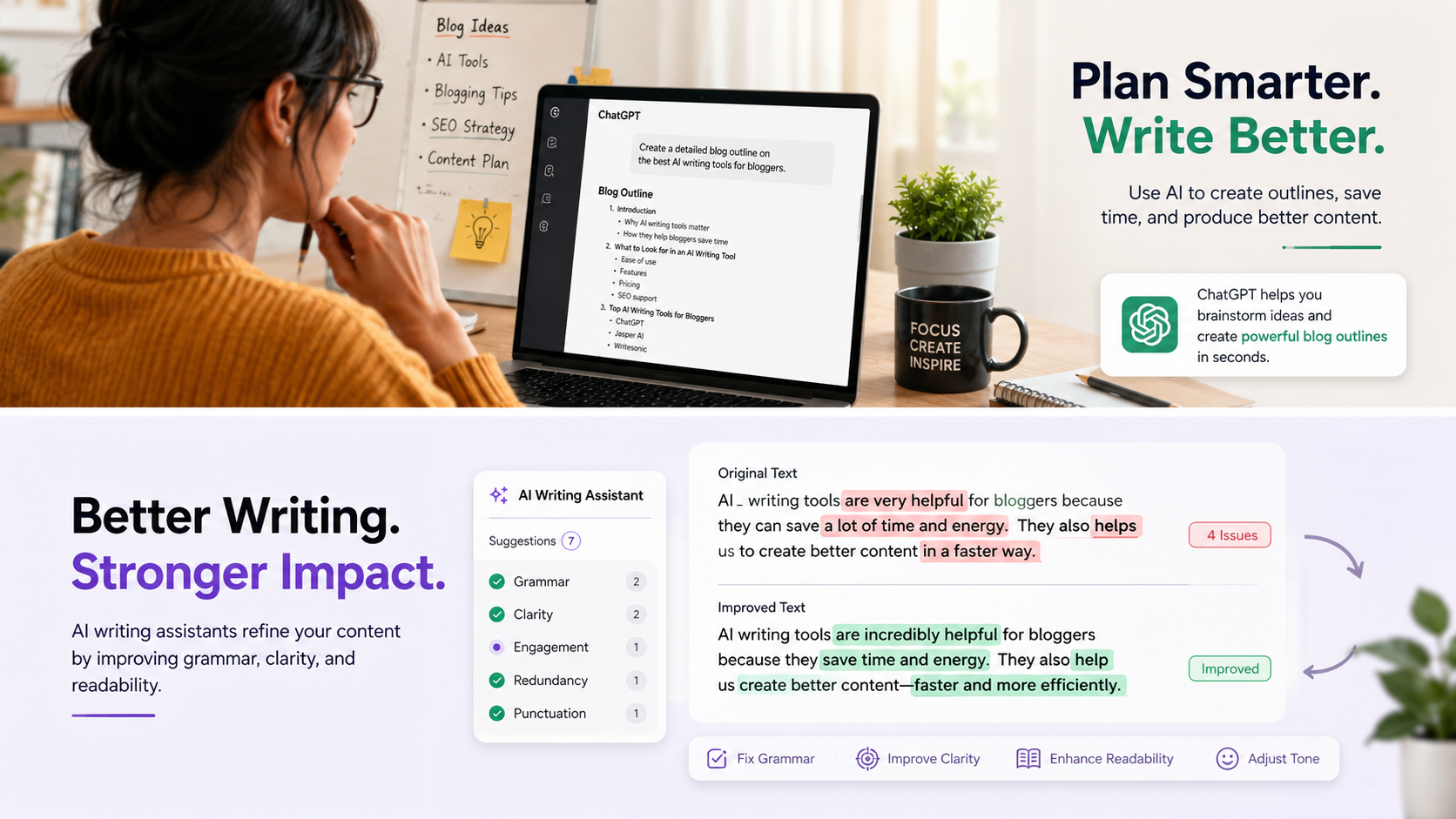
Writing a great blog post used to take hours. You’d stare at a blank page, type a few sentences, delete them, grab another cup of coffee, and hope inspiration would magically show up.
Thankfully, things are different now.
The Best AI Writing Tools for Bloggers can help you brainstorm ideas, write outlines, improve grammar, optimize articles for SEO, and even overcome writer’s block. They’re not here to replace your creativity – they’re here to make writing faster and a whole lot easier.
If you’ve ever wondered which AI writing tool is actually worth paying for, you’re in the right place.
In this guide, we’ll compare the most popular AI writing assistants available today. We’ll look at their strengths, weaknesses, pricing, and the type of blogger each one is best for.
Whether you’re starting your first blog or running a full – time content business, you’ll find a tool that fits your workflow.
Let’s dive in.
Why Bloggers Are Using AI More Than Ever
Blogging has changed dramatically over the last few years.
Publishing one article every now and then isn’t enough anymore. Search engines expect high-quality, helpful content, and readers expect articles that answer their questions quickly.
That means bloggers need to create:
- More content
- Better content
- SEO – friendly content
- Content that actually sounds human
That’s a lot of work.
AI writing tools can save hours every week by handling repetitive tasks while leaving the important thinking to you.
Instead of spending an hour writing an outline, AI can generate one in seconds.
Instead of rewriting awkward paragraphs five times, AI can polish them instantly.
You still make the final decisions, but AI helps you get there much faster.
Read also :- Top AI Skills Employers Want in 2026
What Makes a Great AI Writing Tool ?
Not every AI tool is built for blogging.
Some are great for marketing copy.
Others specialize in research or editing.
The best blogging tools combine several useful features into one platform.
Here are the things that matter most.
1. High – Quality Writing
The tool should create natural, readable content.
Nobody wants blog posts that sound like a robot wrote them.
Good AI writing feels conversational and easy to understand.
2. SEO Support
Great articles aren’t enough if nobody finds them.
Look for tools that help with:
- Keyword placement
- Heading structure
- Meta descriptions
- Content optimization
- Readability improvements
These features can help improve your chances of ranking on Google.
3. Speed
Time is money.
If an AI tool helps you write a complete first draft in twenty minutes instead of three hours, that’s a huge win.
Many bloggers use that extra time to publish more articles or promote existing ones.
4. Easy Editing
The first draft is only the beginning.
A good AI assistant should make it simple to:
- Rewrite paragraphs
- Expand ideas
- Shorten text
- Fix grammar
- Change tone
- Improve clarity
Editing shouldn’t feel like starting over.
5. Affordable Pricing
Let’s be honest.
Most bloggers aren’t running giant publishing companies.
If you’re just getting started, paying hundreds of dollars every month probably isn’t realistic.
Fortunately, several excellent AI tools offer generous free plans or affordable subscriptions.
How We Compared These AI Writing Tools
There are dozens of AI writing platforms available today.
Some promise to write entire books.
Others claim they’ll double your website traffic overnight.
Spoiler alert – they won’t.
Instead of believing marketing hype, we compared these tools using practical criteria that matter to real bloggers.
Our comparison focuses on:
- Writing quality
- Ease of use
- SEO features
- Content accuracy
- Customization
- Pricing
- Learning curve
- Overall value
This helps you choose the right tool based on your needs rather than flashy advertisements.
Read also :- Top AI Skills Employers Want in 2026
Best AI Writing Tools Compared
1. ChatGPT
One of the biggest reasons ChatGPT became so popular is its flexibility.
Unlike many AI writing tools that focus only on blog writing, ChatGPT can help with almost every stage of content creation.
You can ask it to:
- Brainstorm blog topics
- Create detailed outlines
- Write introductions
- Explain complex ideas
- Rewrite paragraphs
- Generate FAQs
- Improve readability
- Create social media posts
- Suggest SEO titles
That’s a pretty impressive list.
Best For
- Beginner bloggers
- Freelance writers
- Affiliate marketers
- Small business owners
- Content creators
Pros
- Extremely versatile
- Easy to learn
- Great brainstorming partner
- Supports long conversations
- Excellent for editing
Cons
- Needs clear prompts
- Can occasionally produce inaccurate information
- Doesn’t replace fact-checking
Real – Life Example
Imagine you’re writing a travel blog about visiting Yellowstone National Park.
Instead of asking AI to “write a blog,” you could ask it to:
- Create an outline
- Suggest keywords
- Write an engaging introduction
- Generate FAQs
- Improve readability
- Rewrite weak sections
The result is a much stronger article because you’re working with the AI instead of letting it do everything.
2. Claude
Claude has become a favorite among writers who work on long-form content.
One thing bloggers appreciate is how well it understands context.
If you’re writing a detailed 4,000 – word guide, Claude usually remembers earlier sections better than many competitors.
That means fewer repeated ideas and smoother transitions between paragraphs.
Another strength is its calm, natural writing style.
Many users say Claude produces content that feels less robotic right out of the box.
Best For
- Long – form blog posts
- Detailed tutorials
- Educational content
- Technical writing
Pros
- Excellent long – form writing
- Strong reasoning
- Smooth transitions
- Easy – to – read output
Cons
- Smaller template library
- Requires careful prompting for SEO optimization
3. Jasper AI
Jasper has been built with marketers in mind from day one.
Instead of acting like a general chatbot, it offers templates for common marketing tasks such as:
- Blog posts
- Product descriptions
- Facebook ads
- Google Ads
- Email campaigns
- Landing pages
This makes Jasper especially useful if your blog is part of a business.
Many content teams also like its brand voice features, which help keep writing consistent across multiple authors.
Best For
- Marketing agencies
- Business blogs
- Brand-focused content
- Content teams
Pros
- Strong marketing templates
- Brand voice tools
- Team collaboration
- Easy workflow
Cons
- More expensive than many competitors
- Best features require paid plans
Can AI Really Help You Rank Higher on Google ?
This is probably the biggest question bloggers ask.
The short answer?
Yes – but not by itself.
Google doesn’t reward content simply because it was written by AI or by a human. What matters is whether the content is helpful, accurate, original, and satisfies the reader’s search intent.
Think of AI as your writing partner, not your replacement.
For example, AI can quickly generate an outline, suggest headings, improve readability, and help you organize your ideas. But it’s still up to you to add personal experience, verify facts, and make sure the article genuinely answers your readers’ questions.
The bloggers seeing the best results are the ones who combine AI with their own expertise. They use AI to speed up the process, then edit and refine the content until it sounds natural and provides real value.
In other words, AI can help you publish better content faster – but your unique insights are what make readers ( and search engines ) want to come back.
Read also :- Top AI Skills Employers Want in 2026
4. Grammarly
Most people think Grammarly is just a grammar checker. That’s true… but only partly.
Over the last couple of years, Grammarly has added AI – powered writing features that can rewrite sentences, adjust tone, shorten paragraphs, and even generate new content.
If you’ve ever finished writing a blog post and thought, “Something feels off,” Grammarly is like having a second pair of eyes.
It won’t magically write your entire article, but it can make your writing cleaner, more professional, and easier to read.
Best For
- Editing blog posts
- Grammar correction
- Improving readability
- Professional writing
Pros
- Excellent grammar suggestions
- Easy browser extension
- Tone adjustments
- Improves clarity
- Works with Google Docs and Microsoft Word
Cons
- Not designed for complete blog creation
- Advanced AI features require a paid subscription
Real – Life Example
Let’s say you’ve written a 2,500 – word article after a long day. You’re tired, and your brain is starting to miss obvious mistakes.
Run it through Grammarly, and you’ll likely catch awkward sentences, repeated words, punctuation errors, and places where the writing can flow better.
Sometimes those small improvements make a huge difference.
Read also :- Top AI Skills Employers Want in 2026
5. Copy.ai
Copy.ai focuses on creating content quickly.
It’s especially useful if you’re constantly writing:
- Product descriptions
- Social media posts
- Marketing copy
- Email newsletters
- Short blog posts
The interface is simple enough that even beginners can start using it within minutes.
If you’re a blogger who also manages Pinterest, Facebook, LinkedIn, or email campaigns, Copy.ai can save a surprising amount of time.
Best For
- Marketing content
- Social media
- Short-form blogging
- Small businesses
Pros
- Beginner friendly
- Fast content generation
- Lots of templates
- Clean dashboard
Cons
- Long – form articles usually need editing
- Less detailed than some competitors
6. Writesonic
Writesonic is one of the better options if SEO is your main focus.
Besides helping you write articles, it includes tools for generating titles, meta descriptions, product content, and marketing copy.
Many bloggers like how quickly it creates first drafts.
That doesn’t mean you should publish those drafts immediately, though.
The smartest approach is to treat Writesonic as a starting point, then rewrite sections using your own experience and voice.
Best For
- SEO bloggers
- Affiliate websites
- Marketing teams
- Website owners
Pros
- Strong SEO features
- Quick article generation
- Multiple content formats
- Easy interface
Cons
- Premium plans can become expensive
- Output sometimes needs fact – checking
Read also :- Top AI Skills Employers Want in 2026
7. Notion AI
If you already organize your work in Notion, adding Notion AI feels natural.
Instead of switching between different apps, you can brainstorm ideas, summarize notes, draft articles, and organize research in one place.
That’s incredibly helpful for bloggers managing multiple websites.
Imagine planning an entire month of content inside one workspace instead of jumping between five different tools.
Best For
- Content planning
- Research
- Blog management
- Productivity
Pros
- Built into Notion
- Great organization
- Fast summaries
- Helpful brainstorming
Cons
- Less powerful than dedicated AI writing tools
- Better as a companion than a primary writer
Quick Comparison Table
| Tool | Best For | Free Plan | SEO Features | Overall Rating |
|---|---|---|---|---|
| ChatGPT | All-around blogging | Yes | Excellent | ⭐⭐⭐⭐⭐ |
| Claude | Long – form writing | Yes | Very Good | ⭐⭐⭐⭐⭐ |
| Jasper AI | Marketing teams | Trial | Excellent | ⭐⭐⭐⭐☆ |
| Grammarly | Editing | Yes | Good | ⭐⭐⭐⭐☆ |
| Copy.ai | Marketing copy | Yes | Good | ⭐⭐⭐⭐☆ |
| Writesonic | SEO blogging | Yes | Excellent | ⭐⭐⭐⭐⭐ |
| Notion AI | Planning | Limited | Basic | ⭐⭐⭐⭐☆ |
Which AI Writing Tool Is Best for You?
The answer depends on what kind of blogger you are.
Choose ChatGPT if…
- You write about different topics.
- You need help brainstorming ideas.
- You want one AI tool that does almost everything.
- You like having conversations while writing.
Read also :- Top AI Skills Employers Want in 2026
Choose Claude if…
- You publish detailed tutorials.
- You write long articles every week.
- You want smoother, more natural writing.
- You work on research-heavy content.
Choose Jasper AI if…
- You run a business blog.
- You have multiple writers.
- Brand consistency matters.
- Marketing is your priority.
Choose Grammarly if…
- You already write well.
- You mostly need editing.
- Grammar mistakes drive you crazy.
- You want polished content.
Choose Writesonic if…
- SEO is your biggest focus.
- You publish affiliate articles.
- You create landing pages.
- You want quick first drafts.
Choose Notion AI if…
- You love staying organized.
- You manage editorial calendars.
- You write while taking research notes.
- Productivity is important to you.
Can You Use More Than One AI Tool ?
Absolutely.
In fact, many professional bloggers do exactly that.
Here’s one possible workflow:
- Brainstorm ideas with ChatGPT.
- Research and expand sections with Claude.
- Optimize titles and SEO elements with Writesonic.
- Proofread everything using Grammarly.
- Store research and publishing schedules in Notion AI.
Each tool has its strengths, and combining them often produces better results than relying on just one.
Tips for Getting Better Results from AI
AI is only as good as the instructions you give it.
Here are a few practical tips:
Be Specific
Instead of saying:
“Write a blog post.”
Try:
“Write a friendly 2,500-word guide for beginner bloggers using simple American English.”
The more context you provide, the better the output.
Add Your Own Experience
Readers appreciate personal stories.
For example:
“I tested three AI writing tools for two weeks and found that ChatGPT saved me the most time when creating outlines.”
That kind of insight makes your content more trustworthy and memorable.
Always Fact – Check
AI can occasionally make mistakes or provide outdated information.
Double-check:
- Statistics
- Dates
- Prices
- Product features
- Technical information
A few extra minutes of verification can protect your credibility.
Edit Before Publishing
Even the best AI – generated draft benefits from a human touch.
Read your article out loud.
If a sentence sounds awkward, rewrite it.
If something feels repetitive, trim it down.
Simple edits can make your writing sound much more natural.
Read also :- Top AI Skills Employers Want in 2026
Common Mistakes Bloggers Make with AI
AI is incredibly useful, but there are a few traps to avoid.
Publishing Without Editing
Never copy and paste an AI draft directly onto your website.
Readers can usually tell when content hasn’t been reviewed.
Ignoring Search Intent
Your article should answer the question your audience is actually asking.
Don’t just stuff keywords into random paragraphs.
Focus on solving the reader’s problem.
Overusing Keywords
Yes, SEO matters.
But repeating Best AI Writing Tools for Bloggers twenty times won’t help.
Use the focus keyword naturally and include related phrases throughout the article.
Forgetting Your Voice
Your readers come back because they enjoy your perspective.
Use AI to speed up writing, but keep your personality in the final version.
Best Practices for Ranking AI-Assisted Content
Want your blog posts to perform well in search results?
Keep these habits in mind:
- Start with keyword research.
- Create helpful, original content.
- Add real examples whenever possible.
- Use descriptive headings.
- Include images with keyword – rich alt text.
- Link to trusted external resources.
- Link to related articles on your own website.
- Update older articles regularly.
- Keep paragraphs short and easy to read.
- Focus on helping readers before worrying about search engines.
Google rewards content that genuinely solves problems.
Helpful External Resources
If you want to learn more about SEO and content quality, these trusted resources are worth bookmarking:
- Google Search Central – https://developers.google.com/search
- Google Search Quality Evaluator Guidelines – https://developers.google.com/search/docs
- HubSpot Marketing Blog – https://blog.hubspot.com/
These resources provide valuable insights into creating helpful, people-first content and improving your website over time.
Read also :- Top AI Skills Employers Want in 2026
Final Words
AI writing tools have become an essential part of modern blogging, but they aren’t magic buttons.
The best results come from combining AI’s speed with your own creativity, experience, and judgment.
If you’re just starting out, ChatGPT is an excellent all – around choice. If you write long, detailed guides, Claude is hard to beat. For marketers and businesses, Jasper AI remains a strong option. Grammarly is perfect for polishing your work, while Writesonic shines when SEO is a top priority. Notion AI helps keep your entire content workflow organized.
At the end of the day, the Best AI Writing Tools for Bloggers are the ones that help you create useful, trustworthy content your audience actually enjoys reading.
Use AI to work smarter – not to replace your voice. That’s the real secret to building a successful blog in 2026 and beyond.
Leave a Reply