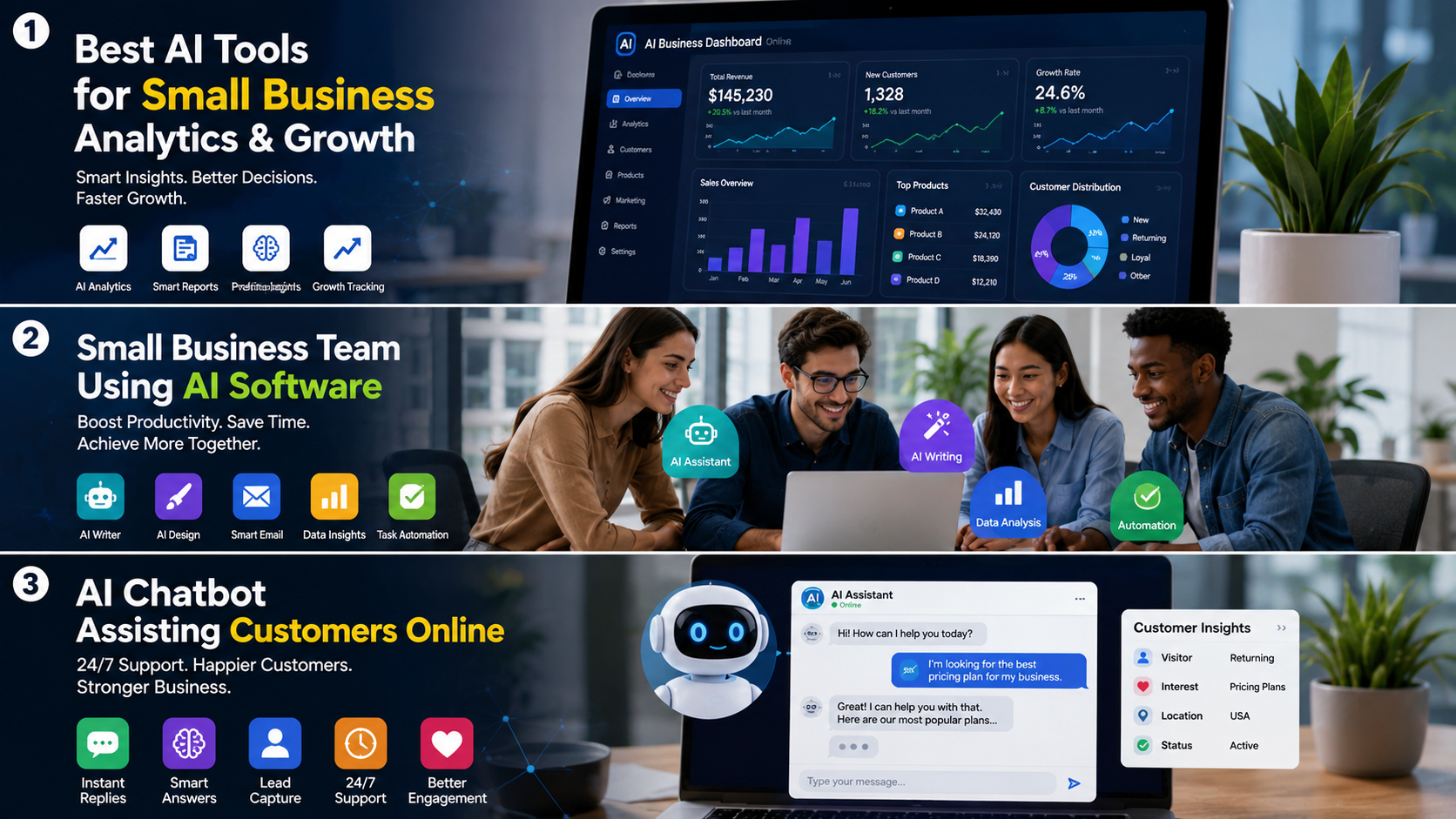
Running a small business isn’t exactly a walk in the park.
One minute you’re answering customer emails. The next minute you’re posting on social media, tracking expenses, updating your website, and somehow trying to find time to actually grow your business.
Sound familiar ?
The good news is that artificial intelligence has become surprisingly useful for small businesses. And no, we’re not talking about robots taking over your office or replacing your employees.
Today’s AI tools help business owners save time, reduce repetitive work, improve customer service, and make smarter decisions.
In fact, many small business owners are now using AI to do tasks that used to require entire teams. That’s a pretty big deal when you’re trying to keep costs low.
In this guide, you’ll discover the best AI tools for small business owners in 2026, how they work, and which ones are actually worth your money.
Why Small Businesses Are Using AI More Than Ever
A few years ago, AI felt like something only giant companies could afford.
Today, that’s changed completely.
Most modern AI tools are affordable, easy to use, and designed specifically for everyday business owners.
Here are some reasons small businesses are adopting AI:
- Save hours every week
- Reduce operating costs
- Improve customer service
- Create marketing content faster
- Analyze business data quickly
- Generate new business ideas
- Automate repetitive tasks
- Increase productivity
According to research from the U.S. Small Business Administration and industry reports, businesses that automate repetitive work often free up valuable time that can be spent on growth and customer relationships.
1. ChatGPT – Best Overall AI Assistant
Official Website:
ChatGPT
If you only choose one AI tool, this would probably be my pick.
ChatGPT can help with:
- Writing emails
- Creating blog posts
- Generating marketing ideas
- Customer support responses
- Product descriptions
- Business plans
- Social media captions
For example, a local bakery owner can use ChatGPT to generate a month’s worth of Instagram posts in less than an hour.
That’s a task that used to take an entire afternoon.
Pros
- Easy to use
- Affordable
- Extremely versatile
- Great for content creation
Cons
- Requires fact – checking
- Can occasionally produce generic content
Read also :- Best AI Tools for College Students in 2026
2. Canva AI – Best for Design
Official Website:
Canva
Most small businesses don’t have an in – house graphic designer.
That’s where Canva AI comes in.
You can create:
- Social media graphics
- Business presentations
- Marketing flyers
- Product mockups
- Advertisements
- Website visuals
The AI features can generate images, write text, and even suggest layouts.
Even if your design skills stop at drawing stick figures, Canva makes professional-looking graphics surprisingly easy.
3. Jasper AI – Best for Marketing Teams
Official Website:
Jasper AI
Jasper focuses heavily on marketing content.
It’s useful for:
- Blog writing
- Email campaigns
- Landing pages
- Product descriptions
- Ad copy
Many e – commerce businesses use Jasper to create product listings much faster than writing everything manually.
4. Grammarly – Best Writing Assistant
Official Website:
Grammarly
Nothing damages credibility faster than spelling mistakes.
Grammarly helps improve:
- Emails
- Website content
- Blog posts
- Business proposals
- Customer communications
Think of it as having an editor sitting beside you all day.
Except this editor doesn’t drink your coffee.
5. HubSpot AI – Best CRM and Sales Tool
Official Website:
HubSpot
Customer relationships matter.
HubSpot’s AI features help businesses:
- Manage leads
- Track sales
- Automate emails
- Analyze customer behavior
- Improve conversions
This is especially valuable for service – based businesses trying to organize customer interactions.
6. Notion AI – Best Productivity Tool
Official Website:
Notion
If your business feels disorganized, Notion AI can help.
It can:
- Summarize meetings
- Generate notes
- Create project plans
- Organize business knowledge
- Draft documents
Many startup founders use Notion as their digital business headquarters.
7. Zapier AI – Best Automation Tool
Official Website:
Zapier
Automation is where AI becomes really powerful.
Zapier connects thousands of apps together.
Example:
When a customer submits a form:
- Add lead to CRM
- Send welcome email
- Notify sales team
- Create follow-up task
All automatically.
No manual work required.
Read also :- Best AI Tools for College Students in 2026
8. Tidio AI – Best Customer Support Chatbot
Official Website:
Tidio
Customers expect quick responses.
Unfortunately, most small business owners can’t stay online 24/7.
Tidio’s AI chatbot can:
- Answer common questions
- Collect leads
- Recommend products
- Handle basic support requests
This improves customer satisfaction without hiring additional staff.
How to Choose the Right AI Tool
Not every business needs every AI tool.
Before subscribing to anything, ask yourself:
What takes the most time ?
If content creation consumes hours every week:
- ChatGPT
- Jasper
If customer support is overwhelming:
- Tidio
If your team struggles with organization:
- Notion AI
If marketing design is difficult:
- Canva AI
The best tool solves your biggest problem first.
Real – Life Example
Let’s imagine Sarah owns a small online jewelry store.
Before AI:
- 3 hours writing social media content
- 2 hours answering repetitive questions
- 4 hours creating product descriptions
- 2 hours making graphics
Total: 11 hours weekly
After AI:
- ChatGPT creates descriptions
- Canva designs graphics
- Tidio answers common questions
Total workload drops significantly.
Those saved hours can be spent finding new customers and improving products.
That’s where real business growth happens.
Common Mistakes Small Businesses Make With AI
Many business owners get excited and buy too many tools.
Don’t do that.
Mistake #1: Buying Every AI Tool
Start with one.
Master it.
Then expand.
Mistake #2: Trusting AI Blindly
Always review:
- Facts
- Statistics
- Legal content
- Financial information
AI is helpful but not perfect.
Mistake #3: Ignoring Human Touch
Customers still want human interaction.
Use AI to support your business, not replace relationships.
Mistake #4: Not Measuring Results
Track:
- Time saved
- Revenue growth
- Customer satisfaction
- Marketing performance
If a tool isn’t helping, reconsider the subscription.
People Also Ask
What is the best AI tool for small businesses ?
ChatGPT is often considered the best all – around AI tool because it can assist with content creation, customer service, brainstorming, and productivity tasks.
Are AI tools worth it for small businesses ?
Yes. AI tools can reduce repetitive work, improve efficiency, and help businesses operate with fewer resources.
Can AI help small businesses make more money ?
Indirectly, yes. AI saves time, improves marketing efforts, enhances customer support, and helps business owners focus on revenue – generating activities.
Which AI tool is best for marketing ?
Jasper AI and ChatGPT are among the top options for marketing content creation.
Is AI expensive for small businesses ?
Many AI tools offer free plans or affordable subscriptions, making them accessible even for startups.
Expert Tips for Getting the Most Out of AI
Here are a few things I’ve noticed successful business owners do:
- Use AI daily, not occasionally.
- Create repeatable workflows.
- Combine multiple AI tools.
- Review AI – generated content.
- Focus on saving time first.
- Invest in employee training.
- Start small and scale gradually.
Small improvements every day often create massive results over time.
How AI Is Changing Small Businesses Faster Than Ever
Just a few years ago, artificial intelligence felt like something reserved for giant corporations with massive budgets. Small business owners often assumed AI was expensive, complicated, and completely out of reach.
Fast forward to 2026, and things look very different.
Today, even a one – person business can access powerful AI tools that automate daily tasks, improve customer service, generate marketing content, and analyze business performance. What once required entire departments can now be handled by software costing less than a monthly coffee budget.
This shift is leveling the playing field.
Small businesses can now compete with larger companies by working smarter rather than simply working harder. Whether you run an online store, a local service company, a consulting business, or a growing startup, AI can help you save time and increase productivity.
The best part ?
You don’t need a computer science degree to use these tools. Most modern AI platforms are built for beginners and can be learned in just a few hours.
Benefits of Using AI Tools for Small Businesses
Many business owners ask a simple question:
“Will AI actually help my business ?”
In most cases, the answer is yes.
Here are some of the biggest benefits businesses are experiencing today.
1. Save Valuable Time
Time is often the most limited resource for small business owners.
AI helps automate repetitive tasks such as:
- Writing emails
- Scheduling appointments
- Responding to customer questions
- Creating social media posts
- Organizing documents
- Managing leads
Saving even one hour per day adds up to more than 365 hours every year.
That’s over nine full work weeks.
2. Reduce Operating Costs
Hiring additional employees can be expensive.
While AI won’t replace talented staff members, it can reduce the need for outsourcing simple tasks.
For example:
- AI writers can assist with content creation.
- AI chatbots can answer basic customer questions.
- AI scheduling tools can handle appointments automatically.
As a result, businesses often spend less while maintaining productivity.
3. Improve Customer Experience
Modern customers expect fast responses.
If someone visits your website at midnight and asks a question, they don’t want to wait until the next morning.
AI chatbots can provide instant assistance around the clock.
This creates a better customer experience and increases trust.
4. Make Better Decisions
Many AI platforms analyze data and identify trends.
Instead of guessing what customers want, business owners can make decisions based on real insights.
This often leads to:
- Better marketing campaigns
- Higher conversion rates
- Increased sales
- Improved customer retention
Read also :- Best AI Tools for College Students in 2026
Best AI Tools by Business Category
Different businesses have different needs.
Let’s break down the best AI tools based on business type.
AI Tools for Online Stores
E-commerce businesses can benefit tremendously from AI.
Recommended tools include:
- ChatGPT
- Jasper AI
- Shopify Magic
- Klaviyo AI
- Canva AI
These tools can generate product descriptions, email campaigns, ad copy, and promotional content.
AI Tools for Local Businesses
Local businesses need customer engagement and visibility.
Recommended tools:
- ChatGPT
- Tidio
- HubSpot
- Canva
- Google Business AI Features
These tools help attract customers, answer questions, and improve local marketing.
AI Tools for Freelancers
Freelancers often wear multiple hats.
Useful AI solutions include:
- Notion AI
- Grammarly
- ChatGPT
- Canva AI
- Zapier
Together, these tools can significantly reduce administrative work.
AI Tools for Marketing Agencies
Agencies often manage content at scale.
Top choices include:
- Jasper AI
- ChatGPT
- Surfer SEO
- Canva AI
- HubSpot AI
These platforms speed up content creation and campaign management.
AI Tools Every Small Business Should Consider
Even if you’re just starting, there are a few AI categories worth exploring.
Content Creation AI
These tools help generate:
- Blog posts
- Emails
- Product descriptions
- Social media content
Examples include ChatGPT and Jasper.
Design AI
Design platforms help create:
- Advertisements
- Logos
- Social media graphics
- Presentations
Canva AI leads this category.
Customer Support AI
Support-focused AI can:
- Answer FAQs
- Handle support tickets
- Collect customer information
Tidio and other chatbot platforms excel here.
Automation AI
Automation tools connect software together and eliminate manual tasks.
Zapier remains one of the strongest options available.
Common Myths About AI for Small Businesses
Many misconceptions prevent business owners from adopting AI.
Let’s clear up a few of them.
Myth #1: AI Is Only for Large Companies
False.
Many AI tools are specifically designed for startups and small businesses.
Myth #2: AI Will Replace All Employees
False.
AI works best as an assistant, not a replacement.
Human creativity, empathy, and decision-making remain essential.
Myth #3: AI Is Too Expensive
False.
Many popular AI tools offer free plans and affordable subscriptions.
Myth #4: AI Is Difficult to Learn
False.
Most platforms are designed for everyday users.
Many people become productive after only a few hours of use.
How to Start Using AI in Your Business Today
Getting started doesn’t need to be complicated.
Follow these simple steps:
Step 1: Identify Your Biggest Problem
Ask yourself:
- Are you spending too much time writing content?
- Are customer questions overwhelming?
- Is marketing taking too much effort?
Find your biggest bottleneck first.
Step 2: Choose One AI Tool
Avoid tool overload.
Start with one platform and learn it thoroughly.
Step 3: Create Simple Workflows
For example:
- Use ChatGPT for blog ideas.
- Use Canva AI for graphics.
- Use Zapier for automation.
Step 4: Measure Results
Track:
- Time saved
- Leads generated
- Customer satisfaction
- Revenue growth
Step 5: Expand Gradually
Once you’re comfortable, add additional AI tools.
This approach prevents overwhelm and improves adoption.
Read also :- Best AI Tools for College Students in 2026
Future Trends in AI for Small Businesses
The AI industry continues to evolve rapidly.
Over the next few years, experts expect:
- More personalized customer experiences
- Smarter AI assistants
- Better automation systems
- Advanced predictive analytics
- Improved voice AI technology
- AI-powered sales assistants
- Enhanced cybersecurity tools
Businesses that adapt early will likely gain a significant competitive advantage.
Read also :- Best AI Tools for College Students in 2026
Final Words
The best AI tools for small business owners are no longer optional luxuries. They’re becoming essential business assets.
Whether your goal is saving time, reducing costs, improving customer support, or increasing revenue, there’s likely an AI tool that can help.
Start small.
Pick one tool.
Use it consistently.
Measure the results.
You’ll probably be surprised by how much time and energy you get back.
In a world where competition grows every day, the businesses that embrace AI today are positioning themselves for success tomorrow.
And honestly, that’s a pretty exciting opportunity.
Leave a Reply