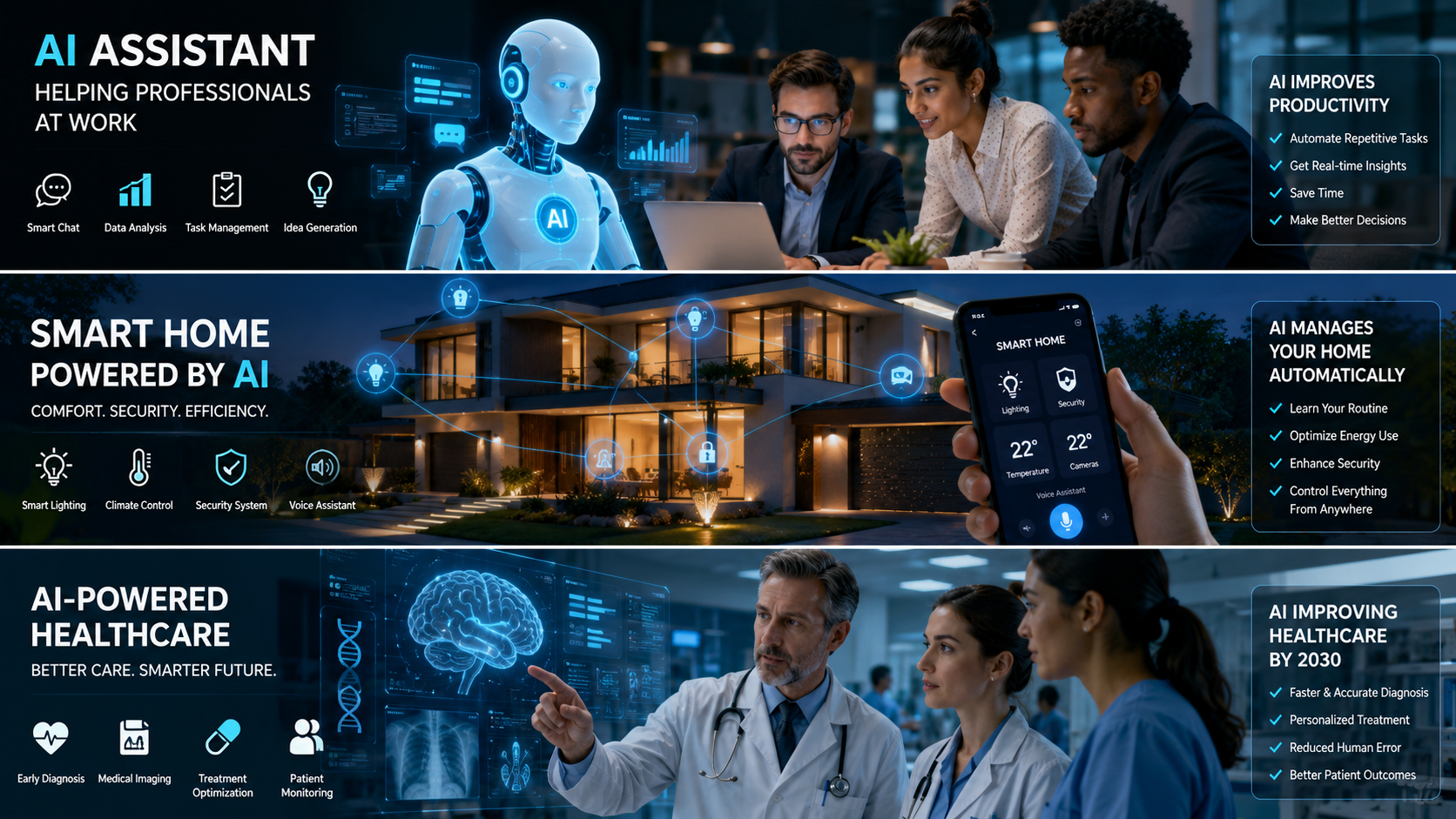
Artificial intelligence has already become a part of daily life. Whether you’re using a chatbot to write emails, getting recommendations from streaming apps, or asking your phone for directions, AI is quietly working behind the scenes.
But here’s the interesting part: what we see today is probably just the beginning.
The Future of AI Tools looks incredibly exciting. By 2030, experts believe AI will become more intelligent, more personalized, and much more useful in everyday situations. Some tasks that currently take hours could be completed in minutes. Businesses may operate more efficiently, students could receive personalized tutoring, and healthcare could become more accurate than ever before.
Of course, not everything will be perfect. There will be challenges, concerns, and important questions about privacy, jobs, and responsible AI development.
In this guide, you’ll discover what AI tools may look like by 2030, how they could impact different industries, and what you can do today to prepare for the AI-powered future.
Why AI Is Advancing So Quickly
A few years ago, AI could barely hold a decent conversation.
Today, AI can:
- Write articles
- Create images
- Generate videos
- Analyze large datasets
- Assist with coding
- Translate languages
- Help with customer support
So why is progress happening so fast ?
Several factors are driving AI growth:
- Better computing power
- Massive amounts of data
- Advanced machine learning models
- Increased business investment
- Growing demand for automation
Major technology companies continue investing billions into AI research, making innovation happen faster than many predicted.
Read also :- 10 Common AI Tool Mistakes Beginners Make (And How to Avoid Them)
What Will the Future of AI Tools Look Like by 2030 ?
The biggest change won’t be that AI becomes smarter.
The biggest change will be that AI becomes nearly invisible.
Instead of opening separate AI applications, you’ll interact with AI naturally throughout your day.
Think about it.
Your calendar may schedule meetings automatically.
Your car may predict traffic before you leave.
Your healthcare app may detect potential health issues early.
Your work software may complete routine tasks without being asked.
AI won’t feel like a tool anymore.
It will feel like a helpful digital partner.
AI Personal Assistants Will Become Truly Intelligent
Today’s AI assistants are impressive, but they’re still limited.
By 2030, personal AI assistants could understand:
- Your preferences
- Your schedule
- Your work habits
- Your communication style
- Your goals
Imagine telling your assistant:
“Plan my business trip next month.”
Within seconds, it could:
- Book flights
- Reserve hotels
- Schedule meetings
- Prepare travel documents
- Estimate expenses
Without you opening ten different websites.
That’s where AI appears to be heading.
Example
Today:
You spend 2 hours organizing a business trip.
By 2030:
Your AI assistant could handle most of the process in minutes.
Sounds nice, right ?
AI Will Transform the Workplace
One of the biggest areas affected by AI will be work.
Contrary to some dramatic headlines, AI probably won’t replace every job.
Instead, it will change how work gets done.
Employees may spend less time on repetitive tasks and more time on creative and strategic work.
Read also :- 10 Common AI Tool Mistakes Beginners Make (And How to Avoid Them)
Tasks AI May Automate
Administrative Work
- Scheduling meetings
- Data entry
- Report creation
- Email drafting
Customer Support
- Answering common questions
- Ticket routing
- Basic troubleshooting
Data Analysis
- Finding patterns
- Creating forecasts
- Generating insights
Content Creation
- First drafts
- Research summaries
- Social media planning
Workers who learn how to collaborate with AI may become significantly more productive than those who ignore it.
The Future of AI Tools in Education
Education could experience one of the most positive AI transformations.
Every student learns differently.
Traditional classrooms often struggle to accommodate individual learning styles.
AI may help solve this problem.
Personalized Learning
Future AI tutors could:
- Identify weaknesses
- Adjust lesson difficulty
- Explain concepts differently
- Track progress
- Provide instant feedback
Imagine having a tutor available 24 hours a day.
That could become normal by 2030.
Benefits for Teachers
Teachers may use AI to:
- Grade assignments
- Create lesson plans
- Generate quizzes
- Track student performance
This could allow educators to spend more time teaching and mentoring students.
AI in Healthcare Will Become More Accurate
Healthcare is another industry where AI tools could create massive improvements.
Doctors already use AI for certain diagnostic tasks.
By 2030, AI may assist with:
- Disease detection
- Medical imaging analysis
- Drug development
- Treatment recommendations
- Patient monitoring
Real – World Possibilities
Imagine wearing a smartwatch that notices subtle health changes before symptoms appear.
The device could alert you and recommend seeing a doctor.
Early detection often saves lives.
AI may help make that happen more frequently.
AI – Powered Smart Homes Will Become Common
Smart homes already exist.
But they’re often limited to simple commands.
Future AI systems may understand context and behavior patterns.
For example:
Your home could automatically:
- Adjust lighting
- Manage energy usage
- Optimize temperature
- Order groceries
- Improve home security
Without constant manual input.
Your house may eventually understand your routines almost as well as you do.
Hopefully better than your teenager remembers to turn off the lights.
Read also :- 10 Common AI Tool Mistakes Beginners Make (And How to Avoid Them)
AI and Transportation in 2030
Transportation is expected to change dramatically.
AI systems may help:
- Reduce traffic congestion
- Improve logistics
- Enhance vehicle safety
- Optimize delivery routes
Self-driving technology is still developing, but AI will likely play a larger role in transportation management over the next decade.
Even if fully autonomous vehicles aren’t everywhere by 2030, AI-assisted driving features will probably become much more advanced.
The Rise of AI Creativity Tools
One surprising trend is how creative AI has become.
A few years ago, many experts believed creativity would remain uniquely human.
Now AI can generate:
- Art
- Music
- Videos
- Marketing campaigns
- Website designs
By 2030, creative professionals may use AI as a collaborative partner rather than a replacement.
Example
A designer could describe an idea.
AI generates:
- Multiple concepts
- Layout suggestions
- Color palettes
- Marketing assets
The human designer then refines and improves the final product.
This combination of human creativity and AI efficiency may become the standard workflow.
How AI Will Impact Small Businesses
Small businesses often have limited budgets and staff.
AI tools could level the playing field.
Business owners may use AI for:
- Marketing
- Customer service
- Inventory management
- Accounting
- Sales forecasting
Tasks that once required entire teams may become manageable for a single entrepreneur.
This could lead to more innovation and business growth.
Will AI Replace Jobs ?
This is probably the question people ask most often.
The answer is complicated.
Some jobs will change.
Some jobs may disappear.
New jobs will also emerge.
History shows that technology tends to transform work rather than eliminate it entirely.
Jobs Likely to Grow
- AI trainers
- Data specialists
- AI ethics consultants
- Cybersecurity experts
- Automation managers
- Human – AI collaboration specialists
People who learn new skills and adapt to technological changes will likely have the greatest opportunities.
Challenges the Future of AI Tools Must Solve
AI offers tremendous potential, but challenges remain.
Ignoring them would be unrealistic.
Privacy Concerns
AI systems require data.
People want assurance that their information remains secure.
Organizations must prioritize transparency and privacy protection.
Bias and Fairness
AI systems learn from data.
If training data contains bias, AI can produce biased results.
Developers must continuously improve fairness and accountability.
Read also :- 10 Common AI Tool Mistakes Beginners Make (And How to Avoid Them)
Misinformation
AI-generated content can sometimes spread inaccurate information.
Users will need stronger critical thinking skills than ever before.
Security Risks
More advanced AI systems could create new cybersecurity challenges.
Protecting digital infrastructure will become increasingly important.
Skills You Should Learn Before 2030
You don’t need a computer science degree to benefit from AI.
However, developing certain skills can help you stay competitive.
Recommended Skills
AI Literacy
Understand how AI works and its limitations.
Critical Thinking
Verify information and evaluate AI outputs.
Communication
Human communication remains valuable.
Creativity
Creative thinking is difficult to automate.
Problem Solving
Complex problem-solving skills will remain highly valuable.
Adaptability
Technology changes quickly.
People who adapt tend to succeed.
People Also Ask
What will AI tools be able to do by 2030 ?
AI tools may handle advanced automation, personalized assistance, healthcare support, education, content creation, business operations, and many everyday tasks with greater accuracy and efficiency.
Will AI replace human workers ?
AI will likely automate certain tasks, but many experts believe it will transform jobs rather than eliminate all human work.
Which industries will benefit most from AI ?
Healthcare, education, finance, transportation, manufacturing, marketing, and customer service are expected to see significant benefits.
Is AI safe for everyday use ?
AI can be safe when developed responsibly, though concerns regarding privacy, security, and bias remain important considerations.
Practical Ways to Prepare for the AI Future
You don’t have to wait until 2030.
Start today.
Here’s a simple action plan:
- Learn basic AI concepts.
- Experiment with AI tools.
- Improve digital skills.
- Follow technology trends.
- Focus on uniquely human abilities.
- Stay adaptable.
- Continue learning throughout your career.
Even small steps can make a big difference over time.
Reliable Sources for Further Reading
- https://www.nist.gov/artificial-intelligence
- https://www.ibm.com/topics/artificial-intelligence
- https://www.mckinsey.com/capabilities/quantumblack/our-insights
How AI Will Change Everyday Life by 2030
When people hear about artificial intelligence, they often imagine robots taking over offices or futuristic machines walking down the street.
The reality will probably be much less dramatic – and much more useful.
By 2030, AI could become so deeply integrated into daily life that most people won’t even think about it. Much like the internet today, AI may simply become part of the background.
Imagine waking up in the morning and having an AI assistant summarize your schedule, weather conditions, important emails, and even traffic updates before you leave the house.
Your smart home might already know:
- What temperature you prefer
- When you usually wake up
- Which lights you use most
- How much energy your household consumes
Instead of manually controlling everything, AI systems may automatically make adjustments that save both time and money.
For busy families, this could be a game changer.
Parents juggling work, school activities, grocery shopping, and household responsibilities may benefit from AI systems that handle routine planning tasks automatically.
The average person may save several hours every week simply by allowing AI tools to manage repetitive tasks.
And honestly, who wouldn’t want a little extra free time ?
AI in Finance: Smarter Money Management
Money management is another area where AI tools are expected to make a major impact.
Many people struggle with budgeting, saving, and investing because financial planning can feel overwhelming.
Future AI financial assistants may help simplify the process.
Imagine an AI tool that can:
- Analyze your spending habits
- Identify unnecessary expenses
- Suggest personalized savings goals
- Monitor investment opportunities
- Alert you about unusual transactions
Instead of looking at confusing spreadsheets, users could simply ask:
“Can I afford a vacation next month ?”
The AI system might instantly analyze income, bills, savings goals, and upcoming expenses before providing a clear answer.
Banks and financial institutions are already using AI for fraud detection today.
By 2030, these systems could become even more sophisticated, helping protect consumers from increasingly complex scams and cyber threats.
Read also :- 10 Common AI Tool Mistakes Beginners Make (And How to Avoid Them)
The Future of AI Tools in Digital Marketing
Marketing professionals are already using AI to create content, analyze customer behavior, and optimize advertising campaigns.
However, today’s tools may seem primitive compared to what arrives over the next few years.
Future AI marketing platforms could:
- Predict consumer behavior
- Generate personalized advertising
- Optimize websites automatically
- Improve customer targeting
- Create multimedia content instantly
For example, an online store may show different product pages to different visitors based on their interests and shopping habits.
The result?
A more personalized experience for customers and better conversion rates for businesses.
Small businesses that previously couldn’t afford large marketing teams may finally have access to enterprise-level capabilities through affordable AI tools.
AI and Cybersecurity: Fighting Digital Threats
As technology evolves, cybercriminals continue finding new ways to attack businesses and individuals.
This creates a constant battle between security experts and hackers.
Fortunately, AI may become one of the strongest weapons against cybercrime.
Future cybersecurity systems could:
- Detect threats in real time
- Identify suspicious behavior
- Stop attacks automatically
- Monitor networks continuously
- Predict potential vulnerabilities
Traditional security methods often react after a problem occurs.
AI systems may help prevent problems before they happen.
This proactive approach could significantly reduce data breaches and online fraud.
For businesses handling sensitive customer information, this advancement could be incredibly valuable.
The Future of AI Tools and Remote Work
Remote work exploded in popularity during the 2020s.
Many companies discovered that employees could remain productive outside traditional offices.
By 2030, AI may make remote work even more efficient.
Imagine virtual meetings where AI automatically:
- Takes notes
- Creates summaries
- Assigns action items
- Translates conversations
- Tracks project deadlines
Instead of spending hours reviewing meeting recordings, team members could receive concise summaries immediately after a meeting ends.
AI-powered collaboration tools may also help distributed teams work together more effectively across different time zones.
For global companies, this could significantly improve productivity.
Ethical Questions About Artificial Intelligence
While the future of AI tools looks promising, it’s important to discuss the ethical concerns that come with powerful technology.
Several important questions remain unanswered.
For example:
- Who is responsible when AI makes mistakes ?
- How should personal data be protected ?
- Can AI systems remain unbiased ?
- Should AI-generated content always be labeled ?
Governments, technology companies, and researchers continue debating these issues.
Creating ethical guidelines will be essential as AI becomes more powerful and influential.
Responsible development may determine whether AI becomes one of humanity’s greatest tools or one of its biggest challenges.
Read also :- 10 Common AI Tool Mistakes Beginners Make (And How to Avoid Them)
Predictions From Industry Experts
Many technology leaders and researchers believe AI will become one of the most transformative innovations in modern history.
While predictions vary, several common themes continue appearing:
AI Will Become More Personalized
Future systems may adapt specifically to individual users.
Human-AI Collaboration Will Increase
Rather than replacing humans, AI will often work alongside them.
Automation Will Expand
Routine tasks across many industries will increasingly become automated.
AI Accessibility Will Improve
Powerful AI tools will become available to more people and businesses.
Regulation Will Grow
Governments worldwide will likely introduce new AI laws and standards.
These trends suggest that AI will become more common, more useful, and more regulated over the next decade.
The Biggest AI Opportunities for Entrepreneurs
Entrepreneurs may benefit enormously from the next generation of AI tools.
Starting a business often requires managing multiple responsibilities at once.
AI can help reduce that burden.
Potential opportunities include:
- AI consulting services
- AI – powered software products
- Automated content creation agencies
- AI education platforms
- AI healthcare solutions
- AI cybersecurity services
Many experts believe the next decade will create entirely new business categories that don’t exist today.
Just as the internet created opportunities that nobody imagined in the 1990s, AI may open doors that are difficult to predict today.
Read also :- 10 Common AI Tool Mistakes Beginners Make (And How to Avoid Them)
Final Thoughts: Preparing for an AI – Powered Future
The future of AI tools is no longer a distant possibility.
It’s actively being built right now.
Every year, artificial intelligence becomes more capable, more accessible, and more integrated into the technologies we use every day.
By 2030, AI may help us work smarter, learn faster, stay healthier, manage finances more effectively, and solve problems that currently seem impossible.
Of course, challenges surrounding privacy, security, ethics, and regulation will remain important.
But if developed responsibly, AI has the potential to improve countless aspects of modern life.
The people who benefit most from this transformation won’t necessarily be technology experts.
They’ll be the individuals willing to learn, adapt, and embrace new opportunities.
The future of AI tools belongs to everyone – not just programmers, engineers, or tech companies.
And based on the speed of innovation we’re seeing today, that future might arrive sooner than most of us expect.
Leave a Reply