AI tools are everywhere right now.
Whether you’re scrolling through social media, reading tech news, or talking to coworkers, someone is probably discussing the latest AI chatbot, image generator, or productivity tool. It almost feels like AI can do everything.
And honestly ? In some cases, it can do some pretty amazing things.
But here’s something interesting.
Despite millions of people using AI tools every day, a huge number of users are disappointed with their results. They try an AI chatbot once or twice, get a weak answer, and decide that AI is overhyped.
Sound familiar ?
The truth is that most people don’t fail because AI tools are bad. They fail because they’re using them the wrong way.
Think about it like buying a professional camera. Simply owning an expensive camera doesn’t automatically make someone a great photographer. The same idea applies to AI.
In this guide, you’ll learn exactly why most people fail to get results from AI tools, the mistakes they make, and the practical steps you can use today to get dramatically better outcomes.
Quick Answer: Why Do Most People Fail with AI Tools ?
Most people fail to get results from AI tools because they:
- Use vague prompts
- Expect instant perfection
- Don’t provide enough context
- Use the wrong AI tool for the task
- Fail to refine and improve outputs
- Treat AI as a replacement instead of an assistant
- Lack a clear goal before starting
If you fix these issues, your results can improve almost immediately.
Read also :- How to Start an Online Business Using AI Tools
The AI Expectation Problem
One of the biggest reasons people struggle with AI is unrealistic expectations.
Many advertisements make AI seem like magic.
You type one sentence.
The AI instantly creates a perfect article, business plan, marketing strategy, website, and maybe even cooks dinner for you.
Reality is a little different.
AI is powerful, but it still depends heavily on human guidance.
Imagine asking a new employee:
“Make my business better.”
What would they do ?
They’d probably have dozens of questions.
AI works similarly.
When users give little information, they often receive generic answers.
Then they blame the tool.
In many cases, the problem isn’t the AI. It’s the communication.
Poor Prompts Create Poor Results
This is probably the biggest mistake people make.
AI tools respond based on the information you provide.
Bad input usually leads to bad output.
Example of a Weak Prompt
“Write me a blog post.”
That’s it.
No topic.
No audience.
No goals.
No style.
The AI has to guess.
And guessing rarely produces excellent results.
Example of a Strong Prompt
“Write a 1,500-word blog post for small business owners in the United States explaining how AI can improve customer service. Use a conversational tone, include examples, and provide actionable tips.”
Notice the difference?
The second prompt gives direction.
The AI understands:
- Who the audience is
- What the topic is
- Desired length
- Writing style
- Specific objectives
As a result, the output is usually much better.
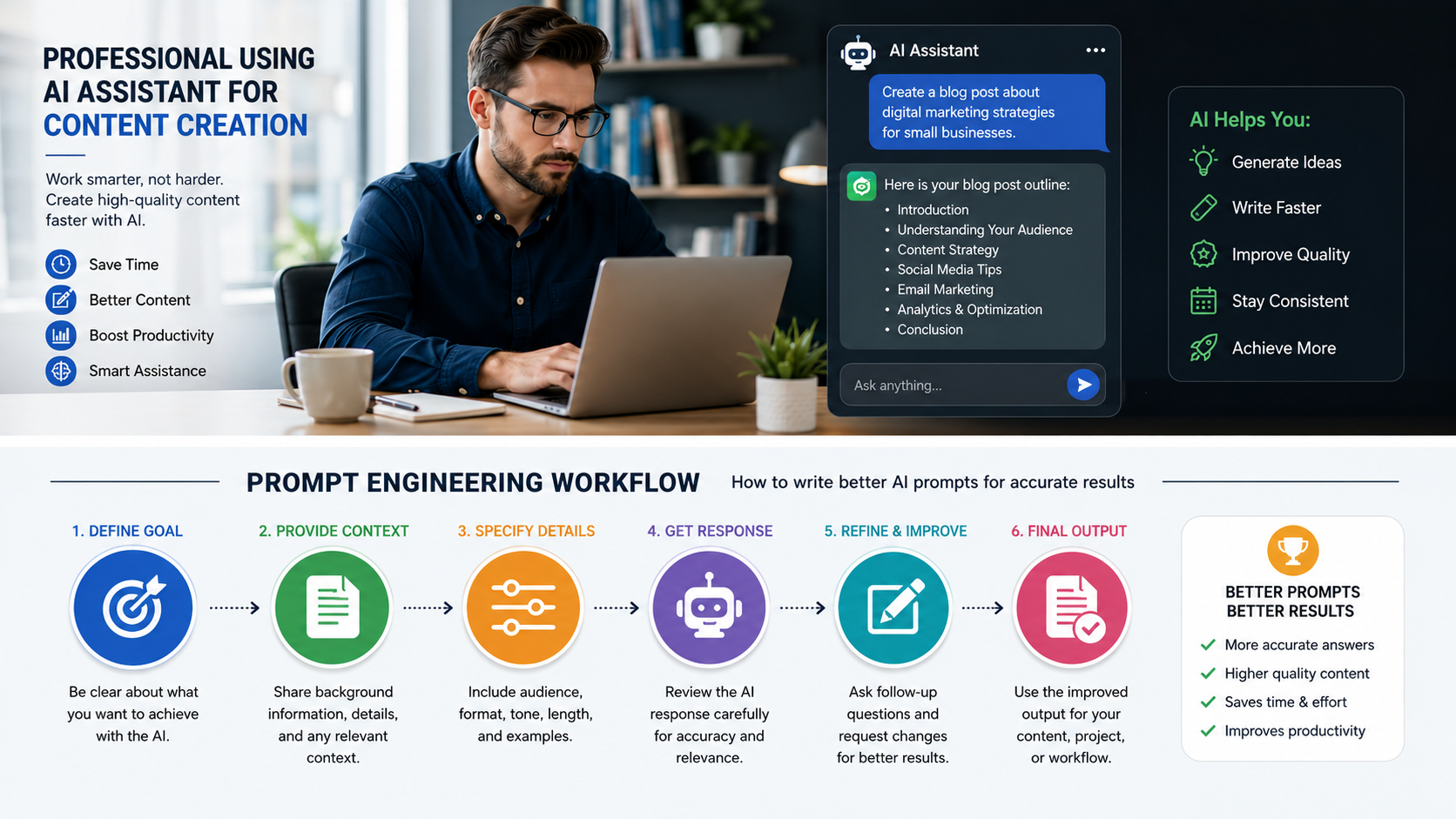
Practical Prompt Improvement Formula
Whenever you use AI, include:
- Goal
- Audience
- Context
- Desired format
- Tone
- Examples if available
A simple formula is:
“Act as [role]. Help me [goal]. The audience is [audience]. Use [style]. Include [requirements].”
This single habit can dramatically improve your AI results.
Most Users Quit Too Early
Here’s something funny.
Many people try AI exactly once.
They ask a quick question.
The answer isn’t amazing.
Then they give up.
Imagine going to a gym one time and saying:
“Well, I still don’t have six – pack abs. This gym doesn’t work.”
Sounds ridiculous, right ?
Yet people do exactly this with AI tools.
Learning how to communicate effectively with AI takes practice.
The good news ?
The learning curve is much smaller than most people think.
Often, a few days of experimentation can produce major improvements.
Read also :- How to Start an Online Business Using AI Tools
People Use the Wrong AI Tool for the Job
Another common problem is choosing the wrong tool.
Not all AI tools are designed for the same purpose.
For example:
Content Writing Tools
Best for:
- Blog posts
- Emails
- Product descriptions
- Marketing content
Image Generation Tools
Best for:
- Graphics
- Illustrations
- Social media images
- Concept art
Coding Assistants
Best for:
- Debugging
- Code generation
- Learning programming
- Technical explanations
Research Assistants
Best for:
- Summaries
- Information gathering
- Idea generation
- Content planning
Trying to use one AI tool for every task is like using a hammer for every home repair project.
Sometimes you need a screwdriver.
Sometimes you need a wrench.
The same principle applies to AI.
Lack of Context Is Destroying Your Results
Context is everything.
Let’s say you ask AI:
“Create a marketing plan.”
For what ?
A restaurant ?
A software company ?
A local gym ?
An online store ?
Without context, the AI must make assumptions.
And assumptions often create average results.
Read also :- How to Start an Online Business Using AI Tools
What Good Context Looks Like
Instead of saying:
“Create a marketing plan.”
Try:
“Create a marketing plan for a small coffee shop located in Austin, Texas. The target audience is college students and young professionals. Monthly marketing budget is $ 500.”
Now the AI has useful information.
The output instantly becomes more relevant.
The more useful context you provide, the better your results typically become.
People Expect AI to Think Like Humans
This is another huge misunderstanding.
AI can sound human.
But it doesn’t think like humans.
It doesn’t have life experiences.
It doesn’t understand emotions the same way people do.
It predicts likely responses based on patterns.
That’s incredibly useful.
But it’s important to remember that AI isn’t reading your mind.
If your instructions are unclear, AI may interpret them differently than you intended.
This is why specificity matters so much.
Real – Life Example: Two Business Owners
Let’s compare two business owners.
Business Owner #1
Uses AI like this:
“Write Facebook ads.”
Gets average results.
Complains AI doesn’t work.
Stops using it.
Business Owner #2
Uses AI like this:
“Write five Facebook ads promoting a family-owned landscaping company in Dallas. Focus on affordable pricing, reliability, and spring lawn care services. Use a friendly tone and include a strong call to action.”
Gets much stronger results.
Continues improving prompts.
Saves hours every week.
Same AI.
Different approach.
Different outcome.
Read also :- How to Start an Online Business Using AI Tools
AI Is Not a Replacement for Thinking
One mistake becoming increasingly common is treating AI as a complete replacement for human thinking.
That approach rarely ends well.
The most successful users treat AI as a powerful assistant.
They use AI to:
- Generate ideas
- Speed up research
- Draft content
- Organize information
- Improve productivity
Then they apply human judgment.
This combination is where the real magic happens.
The best results usually come from:
Human creativity + AI efficiency
Not one or the other alone.
People Also Ask
Why do AI tools sometimes give wrong answers ?
AI models generate responses based on patterns in data. They can occasionally produce inaccurate information, especially when prompts lack context or require highly specialized knowledge.
Can better prompts improve AI results ?
Yes. Better prompts often lead to significantly better outputs because they provide the AI with clearer instructions and expectations.
How long does it take to learn AI tools ?
Most users can improve dramatically within a few days of practice. Advanced skills may take weeks or months, depending on goals and use cases.
Is AI worth using for business ?
Absolutely. When used correctly, AI can save time, improve efficiency, generate ideas, and help businesses scale operations more effectively.
Most People Never Refine the Output
Here’s a secret that experienced AI users understand:
The first response is rarely the final response.
Think about hiring a graphic designer.
You wouldn’t expect the first draft to be perfect. You’d give feedback and ask for revisions.
AI works the same way.
Unfortunately, many people treat the first answer as the final answer.
That’s a mistake.
Example of AI Refinement
Let’s say AI writes an article introduction.
Instead of accepting it immediately, try:
- Make it more conversational.
- Add a real-world example.
- Shorten the introduction.
- Make the tone more professional.
- Add humor.
- Rewrite for beginners.
Within a few rounds, the quality often improves dramatically.
The best AI users don’t settle for the first draft.
They collaborate with the AI.
Information Overload Creates Confusion
Many users open an AI tool and immediately ask it to solve ten different problems at once.
For example:
“Create a business plan, marketing strategy, social media calendar, website content, email campaign, sales funnel, and financial forecast.”
Technically, AI might attempt all of that.
But the results are usually shallow.
A better approach is to break large projects into smaller tasks.
Better Workflow
Step 1: Create customer profiles.
Step 2: Build marketing strategy.
Step 3: Create content calendar.
Step 4: Write individual posts.
Step 5: Analyze and improve.
This structured process produces better outcomes and reduces mistakes.
Read also :- How to Start an Online Business Using AI Tools
Most Users Never Learn Basic Prompt Engineering
The phrase “prompt engineering” sounds complicated.
Honestly, it’s not.
Prompt engineering simply means learning how to ask AI better questions.
The people getting incredible results from AI usually follow a few simple principles.
The CLEAR Prompt Method
C = Context
Explain the situation.
L = Length
Specify desired length.
E = Examples
Show examples when possible.
A = Audience
Identify who the content is for.
R = Role
Tell AI what role to play.
Example
Act as a digital marketing consultant.
Create a 1,000 – word article for small business owners about email marketing.
Use a friendly tone and include practical examples.
This simple structure often outperforms generic prompts.
They Ignore AI’s Limitations
One reason people fail to get results from AI tools is that they expect AI to know everything.
It doesn’t.
AI can sometimes:
- Misinterpret requests
- Provide outdated information
- Create inaccurate facts
- Miss important context
- Oversimplify complex topics
That’s why verification matters.
Smart AI Users Always Verify
Before publishing or acting on AI-generated information:
Fact – check important claims
Verify statistics
Confirm legal information
Review medical information
Check financial advice
Think of AI as a helpful assistant, not an all-knowing expert.
Read also :- How to Start an Online Business Using AI Tools
Fear of Experimentation Holds People Back
Many people are afraid they’ll “break” the AI.
Good news:
You won’t.
AI tools are designed for experimentation.
Some of the best discoveries happen through testing.
Try different:
- Prompt styles
- Content formats
- Writing tones
- Workflows
- Use cases
You’ll quickly discover what works best for your specific goals.
Why Successful AI Users Get Better Results
If you look at people getting outstanding results from AI tools, you’ll notice several common habits.
They Are Curious
They constantly test new ideas.
They Ask Better Questions
They provide detailed instructions.
They Refine Outputs
They improve responses through multiple rounds.
They Understand Limitations
They verify important information.
They Combine Human Skills with AI
They use AI as a partner rather than a replacement.
These habits create a massive advantage.
Practical Steps You Can Use Today
Want better AI results immediately ?
Start with these simple actions.
1. Be Specific
Instead of:
“Write an email.”
Try:
“Write a friendly follow-up email to a customer who requested a quote last week.”
2. Provide Context
Tell AI:
- Who you are
- What you’re trying to achieve
- Who the audience is
- Any important background information
3. Request Multiple Versions
Ask for:
- Version A
- Version B
- Version C
Then choose the best one.
4. Use Follow – Up Questions
Don’t stop after one response.
Ask:
- Can you improve this ?
- Make it shorter.
- Add examples.
- Make it more persuasive.
5. Review Before Using
Always check accuracy and quality.
This step alone can prevent major mistakes.
Read also :- How to Start an Online Business Using AI Tools
The Future Belongs to AI – Enhanced Humans
There’s a lot of debate about whether AI will replace jobs.
A more realistic view is that people who know how to use AI effectively will outperform those who don’t.
Think about calculators.
They didn’t eliminate accountants.
They made accountants more productive.
The internet didn’t eliminate writers.
It changed how writers work.
AI is likely to follow a similar path.
The winners won’t necessarily be the people with the most advanced technology.
They’ll be the people who learn how to use technology effectively.
Common Signs You’re Using AI Incorrectly
If any of these sound familiar, you may need to adjust your approach.
- You use one – sentence prompts.
- You expect perfect results instantly.
- You never provide context.
- You rarely ask follow – up questions.
- You don’t fact – check outputs.
- You use the same AI tool for every task.
- You gave up after one disappointing experience.
The good news ?
Every one of these issues is easy to fix.
HWhy Most People Fail to Get Results from AI Tools (Key Takeaways)
Let’s summarize the biggest reasons people struggle with AI:
- Poor prompts
- Lack of context
- Unrealistic expectations
- Using the wrong tools
- Failure to refine outputs
- Ignoring limitations
- Lack of experimentation
- Expecting AI to think like humans
Once you understand these challenges, your results can improve dramatically.
Read also :- How to Start an Online Business Using AI Tools
Final words
The truth about why most people fail to get results from AI tools is surprisingly simple.
Most failures have very little to do with the technology itself.
Instead, they come from unrealistic expectations, weak prompts, lack of context, and a failure to treat AI as a collaborative tool.
The good news is that these problems are completely fixable.
Start giving better instructions.
Provide more context.
Experiment with different approaches.
Refine your outputs.
And most importantly, remember that AI works best when combined with human creativity and judgment.
If you do that consistently, you’ll quickly move ahead of the average user and unlock far more value from today’s AI tools.
The next time someone says AI doesn’t work, you’ll probably know exactly why.
Leave a Reply